


Privacy in an open-plan office – what to do when employees report discomfort
Contents
- Privacy in an open-plan office - what to do when employees report discomfort
Lack of privacy in an open-plan office usually does not mean that someone is deliberately looking over other people’s shoulders. The problem is rather the constant feeling of being visible and the lack of control over when we can create more privacy for ourselves. This applies both to everyday work at a desk and to meetings in glass-walled rooms or conversations that require discretion.
Office managers often hear comments from employees who feel observed, complain about the lack of privacy in conference rooms, or do not have a suitable place for a confidential conversation. Such situations can affect workplace comfort, but solving them does not always require redesigning the office or adding new walls. Sometimes, it is enough to adapt the existing glazing properly.
What employees mean when they say they lack privacy
Lack of privacy in an office can mean several different problems. It is worth distinguishing between them, because not all of them can be solved in the same way.
- Lack of privacy during conversations: Sound carries across the office, making it difficult to hold confidential conversations without worrying that other employees will hear them.
- Visibility of screen content: People passing by a workstation may be able to see displayed messages, documents, or client data.
- Movement behind glass: During meetings in glass-walled rooms, participants may be distracted by what is happening on the other side of the glass, such as people walking past or employees waiting outside the entrance.
- Lack of discretion during one-to-one meetings: In glass-walled offices and conference rooms, recruitment interviews, performance reviews, or meetings with a manager may take place in full view of the entire team.
The first issue concerns acoustics and requires solutions that limit the spread of sound, such as acoustic panels or properly separated rooms. The remaining situations concern visual privacy, meaning the ability to limit what people outside can see through the glazing. This is the issue we will focus on in the rest of the article.
Why this is not just a matter of comfort
Lack of privacy in the office can easily be seen as a minor inconvenience that employees will eventually get used to. Research shows, however, that it may affect not only everyday comfort, but also job satisfaction and engagement.
A study published in Frontiers in Psychology analysed the experiences of 456 employees across 20 offices of a single architecture firm. People working in open-plan spaces who perceived the lack of privacy as an obstacle to performing their duties were more likely to feel irritation. This was associated with lower job satisfaction, lower engagement, and a poorer assessment of their fit with the work environment. Importantly, the participants in the study were architects and designers, people who professionally deal with spatial design.
Similar conclusions about the importance of visual privacy come from a study by Jungsoo Kim and Richard de Dear, which compared different office layouts. Users of private offices reported the lowest dissatisfaction with their level of visual privacy. As the degree of workstation enclosure decreased, privacy ratings became less favourable.
The findings of these studies highlight an important point: privacy is not only about the absence of people in the immediate surroundings, but also about the ability to control one’s own visibility. Employees do not always need separate, enclosed offices. Often, what they need is the option to temporarily separate themselves from the open space, for example during an important conversation, a meeting, or work that requires greater focus.
Privacy is not blackout
When it comes to glazing, it is worth distinguishing between two functions that are often confused: providing privacy and darkening a room. Visual privacy means limiting visibility through the glass so that people on the other side cannot make out the details of the interior. Blackout, on the other hand, means reducing the amount of light entering the room. SONTE film provides privacy, but it is not designed for blackout. As a result, even when switched to its frosted state, the interior remains bright.
This is how SONTE White works: a smart liquid crystal film installed on existing glass. It uses PDLC technology, in which liquid crystals change their alignment under electrical voltage. Without power, they are arranged irregularly and scatter light, making the film frosted. When the power is switched on, the crystals align in an orderly way, allowing light to pass through and making the glass transparent.
The effect can be compared to frosted bathroom glass, with one key difference: with SONTE, the frosted effect can be switched off at any time.
Where can visibility be changed in an open-plan office?
In practice, SONTE film can be used wherever glazing should sometimes open up the space and, at other times, provide privacy. The most common applications include glass walls in conference rooms, glazed offices next to open-plan areas, partitions between zones, and doors.
When the power is switched off, the film becomes frosted and limits visibility through the glass. The image on the other side is no longer clear, and the glazing turns into a bright, evenly illuminated surface. This is due to the high level of light diffusion, defined by the haze parameter, which is at least 95% for SONTE film.
When the power is switched on, the film becomes transparent. It transmits around 87% of daylight, allowing the room to retain its bright and open character.
A good example of this type of application is the Clariant office at Monopolis in Łódź, where SONTE film was installed on glass walls and doors in an open-plan space. There is no need to modernize the entire office straight away. The film can be applied only in selected areas, with additional glazing fitted later when the need arises.
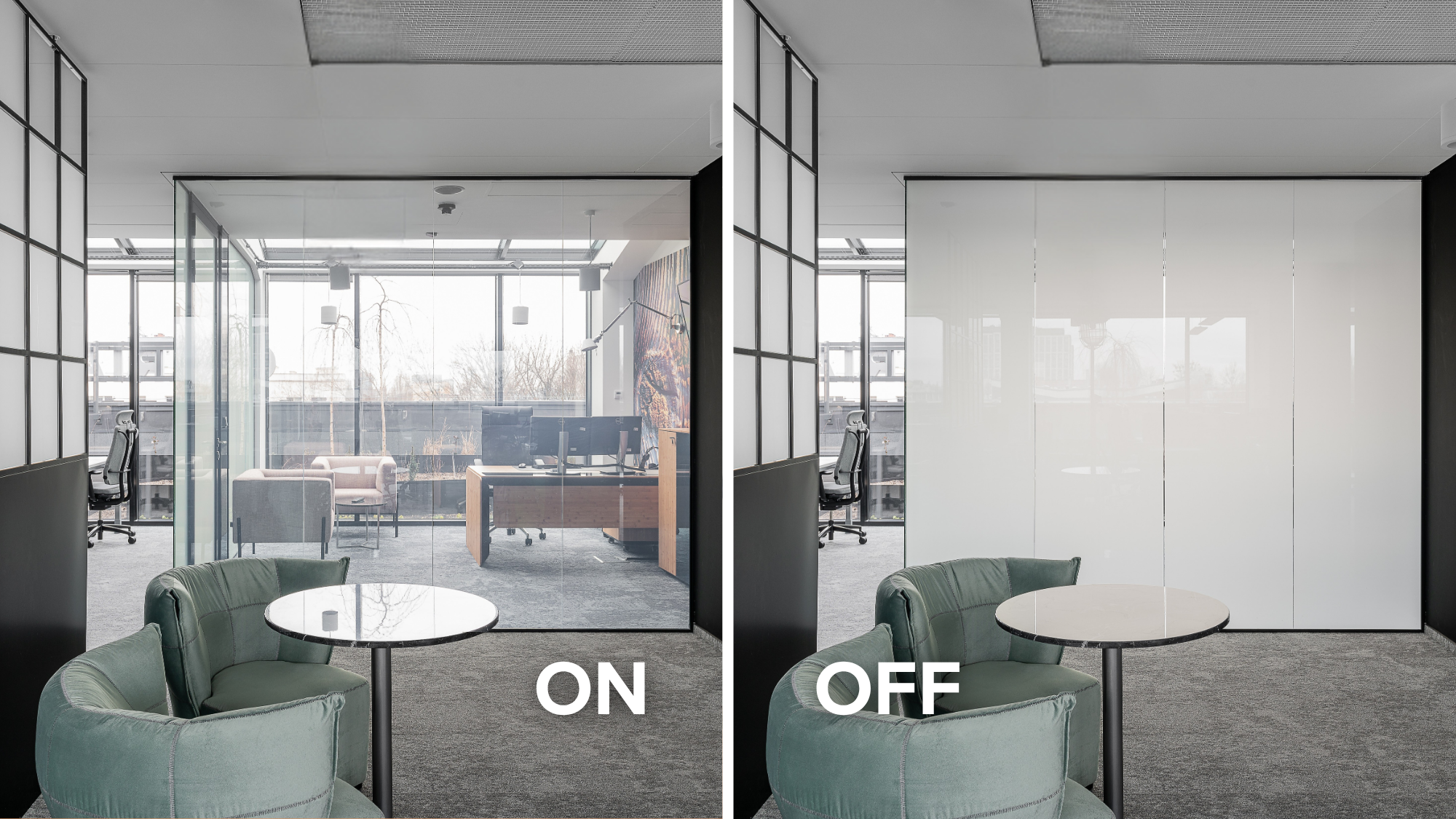
One room, different functions throughout the day
Without power, SONTE film is frosted. This is its default state, which is why it does not consume energy in this mode. Power is only needed when the film is switched to its transparent state. Energy consumption is then around 6 W per square metre.
In practice, this makes it possible to adapt the glazing to how the room is being used. A conference room can remain transparent for most of the day, and then become a private space during a meeting. There is no need to redesign the interior or add extra walls.
Transparency can be controlled using a button, a schedule, or a building management system. Individual glass sections can also be divided into independent zones, with each one controlled separately. We describe more of these possibilities in our article on integrating SONTE film with BMS and KNX systems.
Where this solution works best
First and foremost, it works well in conference rooms located next to open-plan office areas. During a meeting, the film can provide privacy and reduce distracting movement visible on the other side of the glass. Once the meeting is over, the glazing becomes transparent again and opens the room back up to the rest of the office. It works in a similar way in glass-walled offices, which can remain a visual part of the open space on a daily basis, while providing privacy whenever needed.
This solution also works well in HR areas and rooms used for recruitment interviews, performance reviews, or one-to-one meetings with employees. People inside are then no longer visible from the open-plan area or corridor, and once the conversation is over, the room can become visually open again.
A separate category includes leased offices and existing spaces where major redevelopment is either not possible or simply not justified. SONTE film is installed on existing glass, so the privacy function can be added without replacing entire glazed sections or carrying out extensive construction work.
An open-plan office does not have to be open all the time
Open-plan offices were designed to make communication, collaboration, and the free flow of information between employees easier. An open space serves these purposes well, but not every situation during the day requires the same level of openness.
Everyday teamwork, a client meeting, and a one-to-one conversation with an employee all require different conditions. That is why the ability to change the transparency of glazing makes it easier to adapt the office to current needs, without giving up the benefits of an open space. In this way, one room can serve different functions, supporting both easy communication and privacy whenever it is needed.
If employees regularly raise concerns about the lack of privacy in the office, it is worth looking at individual glass partitions and identifying where switchable transparency would bring the greatest benefit. The SONTE team can help assess the space and indicate which rooms are best to start with.
Frequently asked questions (FAQ)
Does SONTE film soundproof a conference room?
No. SONTE film limits visibility through the glazing, but it does not provide acoustic insulation. If noise is the problem, it is worth using additional solutions, such as acoustic panels or suitable finishing materials.
Can the film be installed in just one conference room?
Yes. There is no need to install the film on all glass partitions at once. You can start with one room and equip additional areas with the film gradually, depending on your needs and available budget.
Will the room become darker when the film is switched to its frosted state?
Not in the same way as with blackout blinds. In its frosted state, the film diffuses daylight, so the room remains bright while visibility through the glazing is limited.
Does film installation require the office to stop working?
No, there is no need to take the entire office out of use. SONTE film is installed directly on existing glass, without replacing it. The work can be planned in a way that limits disruption to the company’s daily operations. You can find more information in our article on SONTE film installation in an office.
Can SONTE film be removed when the office layout changes or during a relocation?
Yes. The film can be removed from the glazing without damaging it. However, it is important to remember that once removed, the film cannot be installed again on another pane of glass.
Can employees change the transparency of the glazing themselves?
Yes. Depending on the selected control method, employees can change the transparency using a button or remote control. Automatic control according to a schedule is also possible, as well as integration with a building management system.
How much electricity does SONTE film use?
In its transparent state, SONTE film consumes around 6 W per square metre. When the power is switched off, it changes to its frosted state and does not consume electricity.
Looking to use SONTE Smart Film in your project? Get in touch with us, and we’ll help you find the best solution.