
What is liquid crystal film and how does smart glass work?
For years, glass in buildings served one fixed purpose. If privacy was needed, frosted glass or another permanent solution was used to limit visibility. As a result, the space lost flexibility, and the user had to accept one fixed way of using it.
Technological development has changed the way we think about glass. Today, its properties can be adjusted in real time, depending on the situation and the user’s needs. A single pane of glass can provide full transparency one moment and limit visibility the next, increasing the level of privacy.
This is how intelligent liquid crystal film works, also known as smart film or smart glass. It is a material installed on the surface of glass. When electrical voltage is applied, it changes its structure and the way it transmits light. The entire process takes a fraction of a second and can be controlled with a simple switch, remote control, or building automation system. In practice, this means greater control over how a space functions.
How smart film works on glass
The way it works is based on microscopic liquid crystals enclosed within the structure of the material. These crystals determine whether light passes freely through the glass or is diffused.
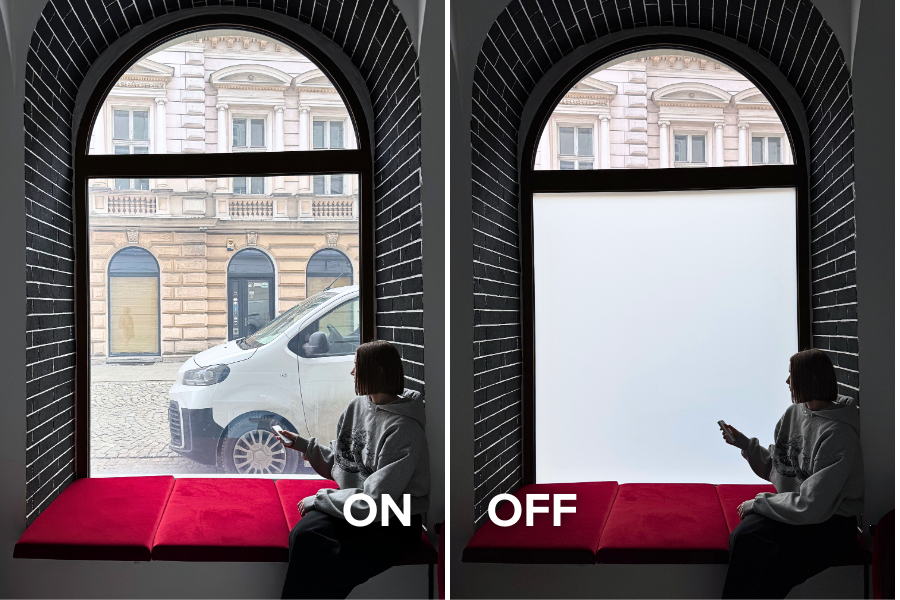
When the film is not powered, the crystals are arranged randomly. In this state, light is scattered, and the glass becomes frosted.
When electrical voltage is applied, the crystals align in one direction. This allows light to pass through the glass, making the surface transparent.
In practice, it is very simple:
- power off: the glass is frosted, for example milky white
- power on: the glass is transparent
Frosted vs. transparent: what this means in practice
This is one of the most important aspects of how the film works, and it often raises questions.
The frosted state does not mean the room becomes completely dark. It means that light is diffused and visibility through the glass is limited. Natural light still enters the space, but people on the other side cannot see details.
In transparent mode (ON), the film provides high visibility through the glass, but it also introduces a slight level of light diffusion, known as haze. This means that the image seen through glass with the film may be slightly less sharp than through glass without film. This is a natural feature of liquid crystal technology.
The quality of the material and its optical parameters are crucial. In the case of SONTE film, transparency is among the highest available on the market, which translates into very good visibility and everyday user comfort.
Transparency parameters in ON mode:
- White SONTE film: VLT above 93% – the highest transparency offered on the market
- Gray SONTE film: VLT above 90%
- Black SONTE film: VLT above 84%
In practice, this means that users maintain very good visibility through the glass while still being able to instantly limit visibility whenever privacy is needed.
What liquid crystal film is made of
Liquid crystal film consists of several layers arranged one on top of another. You can think of it like a sandwich, where each layer has its own role, and only together do they ensure the technology works properly.
The key components are:
- Protective layers
They protect the film against damage and wear during everyday use. They are responsible for the product’s durability from the very first day after installation. - Adhesive layer
This layer allows the film to be installed directly on glass. The installation takes place without traditional adhesives and without unpleasant odors. - PET layers
Two polyester layers, one on each side. They stabilize the entire structure and keep all components in the correct arrangement. - Liquid crystal layer
This is the most important part of the technology. Without power, the crystals scatter light and the glass appears frosted. When voltage is applied, they align in one direction, making the glass transparent. - Conductive layer
Invisible, but essential. It distributes the voltage evenly and ensures that the mode change happens instantly across the entire glass surface.
This layered structure allows the film to work reliably, respond quickly when switching modes, and maintain its properties for years of use.
Smart film vs. smart glass: are they the same?
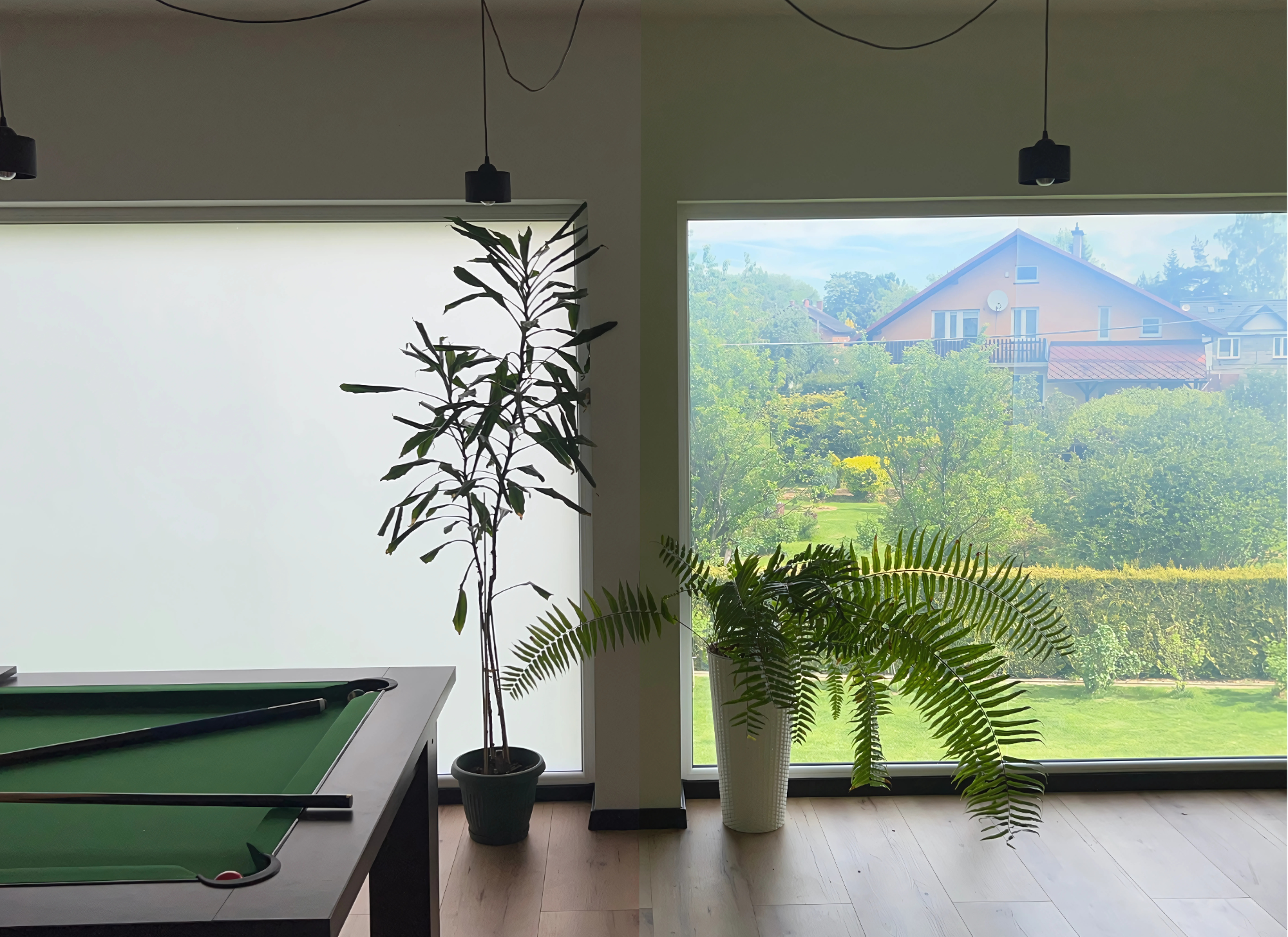
The terms smart film and smart glass are often used interchangeably because they are based on the same liquid crystal technology and work in the same way. The main difference lies in how they are applied and how flexible the solution is in practice.
Smart film is applied directly to an existing pane of glass. This makes it possible to introduce smart glass technology into an already functioning building without replacing the glazing or interfering with the structure of walls, frames, or partitions.
This solution offers a high level of design and user flexibility. It makes it easier to modernize a space, shortens the implementation time, and allows you to respond to future changes, such as office redesigns, changes in room function, or installation servicing.
Smart glass, on the other hand, is glass in which the liquid crystal technology is integrated at the factory between the glass panes.
In practice, many companies and investors choose smart film precisely because it is more flexible to use and service. The technology can be implemented faster, adapted more easily to an existing space, and modified if needed without interfering with the entire glazing system.
Both solutions have their place, but in modernization and adaptation projects, smart film gives greater control over the investment process and the later use of the space.
Where smart film is most commonly used
Smart film technology is not a solution reserved for just one industry. Its application depends primarily on the user’s needs and the character of the space.
The most common applications include:
- conference rooms
- medical offices
- offices and open spaces
- hotels and spas
- bathrooms and bedrooms
- shop windows
- glass doors and partitions
- building façades
If you want to see specific examples of applications and check whether this solution makes sense for your space, read:
👉 Is smart film right for you? How to define your needs before choosing a film