

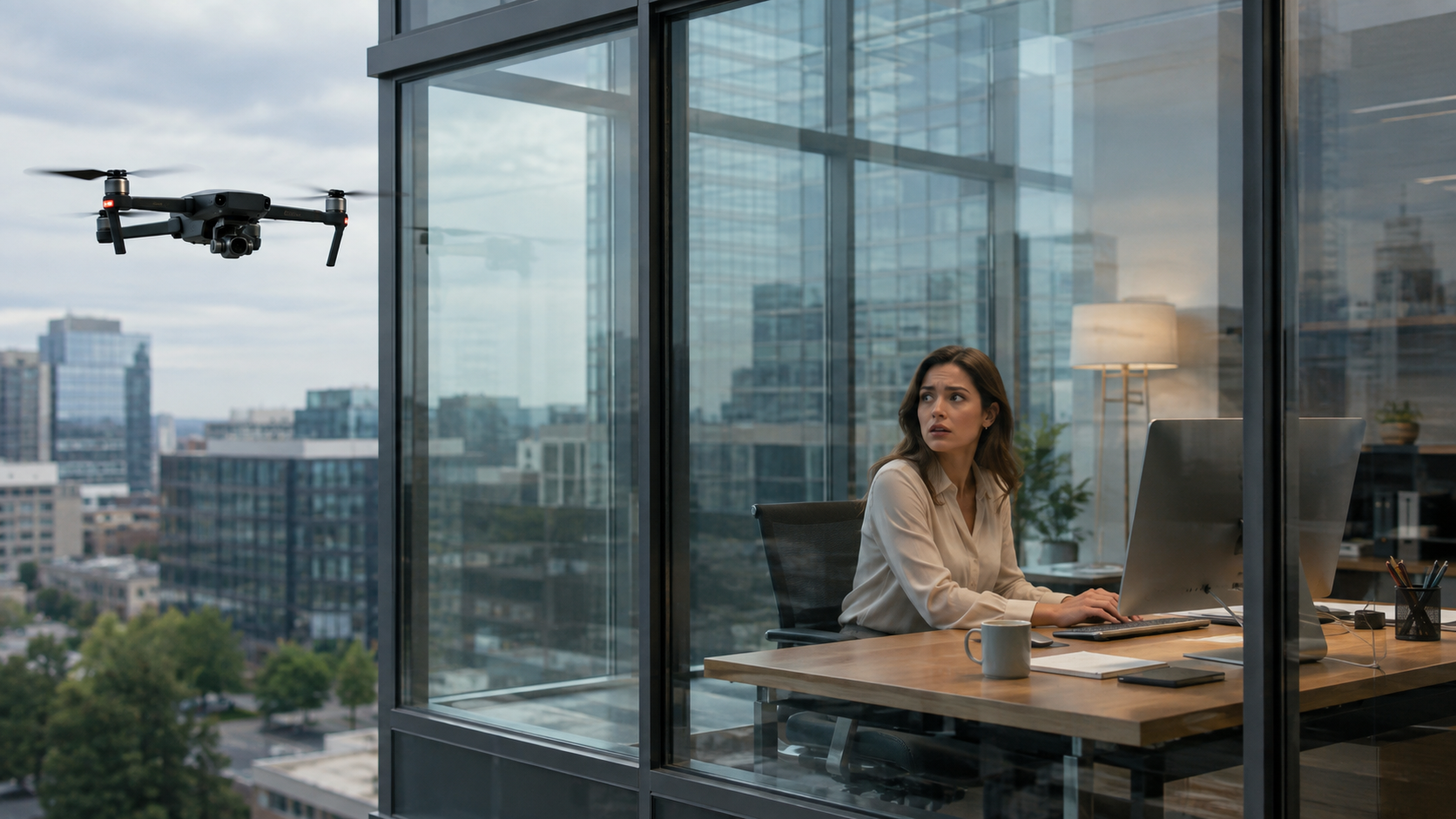
Drones and office privacy – how to limit visibility from outside
The whole problem comes down to one question: what can be seen through the windows when a drone flies over the building? You cannot chase a drone away from a building or ban it from flying over the city. But you can make sure there is nothing to see. All it takes is glass that can change from transparent to opaque, and then return to its previous state. The room stays bright. The interior cannot be seen from outside.
Just a few years ago, no one in companies really thought about this. Privacy in the office meant closed doors and blinds on windows facing the street. Today, drones fly over buildings, often without warning and with no clear owner in sight, and management teams are beginning to ask whether their headquarters are properly protected in this respect. Usually, no one knows the answer, because no one has ever checked it. So let’s start from the beginning: where this question came from, what can really be seen through a glazed façade, and why regulations only help once the damage has already been done.
Why companies started asking about this
The availability of equipment has changed. Drones are no longer tools used only by specialists. They have become devices that can be bought in an electronics store. The security industry describes this directly: unmanned aerial vehicles are now widely available, relatively inexpensive, and easy to use. They can be used for both industrial espionage and sabotage, while security institutions point out that they are appearing more and more often near critical infrastructure.
This is not a theoretical issue. In 2026, an employee of a lignite mine in Greater Poland found an unmanned aerial vehicle on the site. The authorities confirmed that it was not armed, no one was injured, and no damage occurred. But the very fact that the device entered an industrial site and no one noticed it in flight says enough.
For an office building, one number matters in particular. In most cases, the maximum permitted flight altitude for a drone is 120 metres above ground level. That is roughly thirty storeys. In practice, almost every floor of a Polish office building falls within this range, including the floors where management teams sit.
What can be seen through a glazed façade
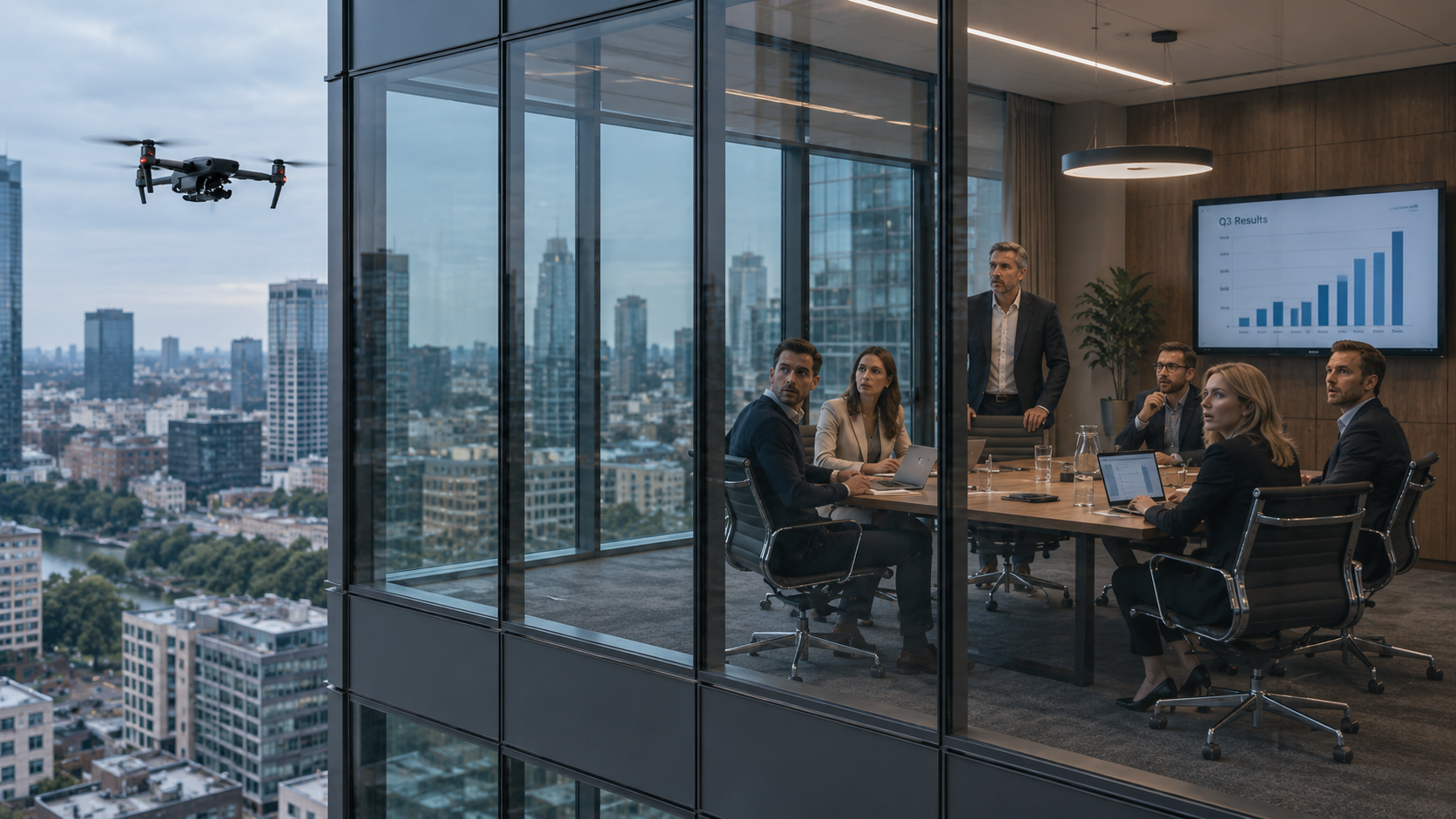
It is worth taking the emotion out of this topic from the start. Most of the time, almost nothing can be seen from outside, and not every glazed surface is a problem. Visibility depends on three things: the balance of light on both sides of the glass, the viewing angle, and the type of glazing.
The first factor is key. Glass reflects the image on the brighter side. On a sunny day, it is many times brighter outside than inside the office, so the façade acts like a mirror and the observer sees the sky reflected in it. But in cloudy weather, at dusk, or simply when the interior is strongly lit, that balance shifts, and the inside becomes visible from outside.
The viewing angle from the air is also more favourable to the observer than the view from the pavement. From street level, you can see part of the ceiling and the upper section of the room. From above, at an angle, horizontal surfaces become visible, such as desks, conference tables, and documents.
Most companies have never checked this, because for the past twenty years there has been no reason to look at their own building from this perspective.
What the regulations say
The natural reaction is: if someone is looking into our windows, surely that is not allowed. The answer is more complex, and that is exactly why it is worth understanding.
In Poland, simply flying a drone over someone else’s property, without recording and without entering no-fly zones, is permitted. The line is crossed when recording begins: filming windows and building interiors may be considered a violation of privacy, and in cases involving cameras covering someone else’s property without a justified need, Polish courts have treated this as an unlawful infringement of personal rights. The same analogy is applied to drones.
Legal protection therefore does exist, but it works at a specific point: once the damage has already been done. Proceedings begin after someone has seen, recorded, and potentially used what they saw. For a management board, that is little comfort. Winning a case does not undo the fact that the content of a document or a slide from a meeting has already left the building.
It is also worth knowing that the new technical powers introduced in 2026 do not apply to a regular office building. Since 26 June 2026, operators of critical infrastructure have been legally allowed to use devices that interfere with radio signals. Previously, if an unauthorized drone appeared, they had to wait for the relevant services to intervene. This is an important change, but it applies to a narrow group of facilities.
What remains is an approach that works regardless of who is flying over the building and for what purpose: limit what can be seen through the glass.
Privacy is not blackout
Before we move on to the solution, we need to separate two concepts that are most often confused in conversations.
Visual privacy means that shapes, silhouettes, and content displayed on screens are not visible through the glass. Blackout means no light in the room. These are two different functions, and they are delivered by different products. The solution described below provides the first, not the second. The room remains bright.
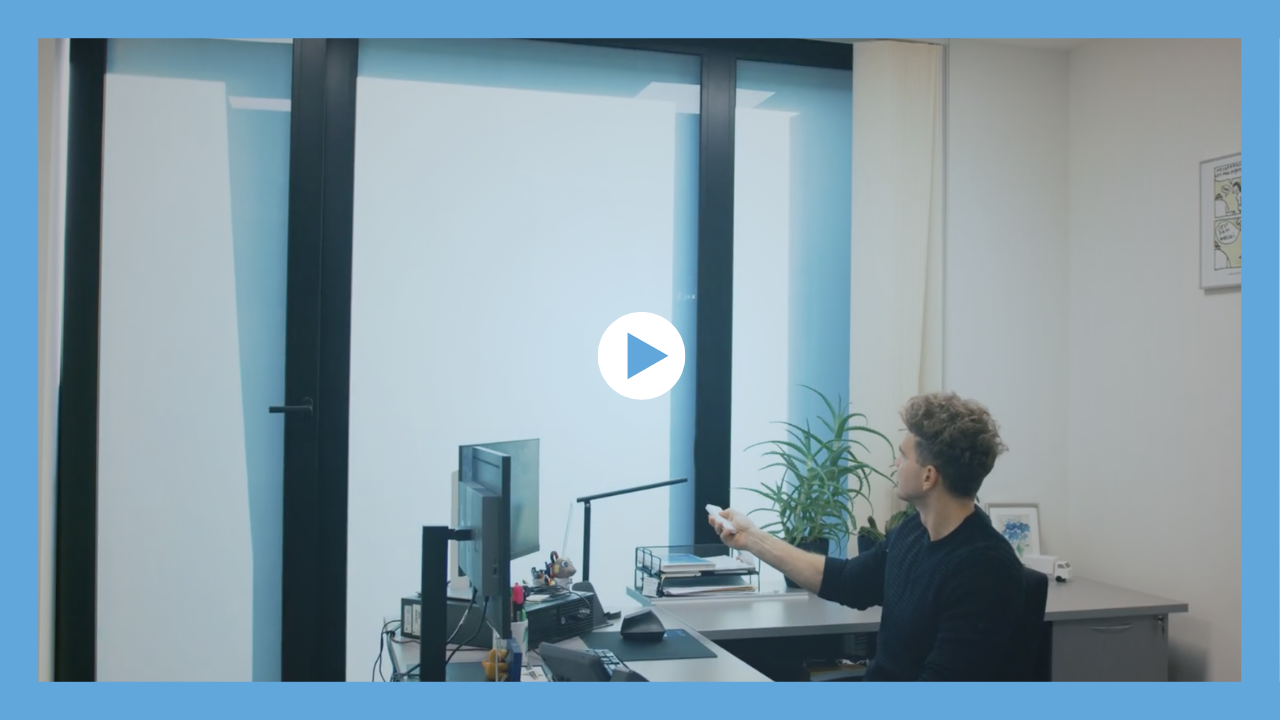
We are talking about SONTE, a liquid crystal film applied to existing glazing, which changes from opaque to transparent when voltage is applied. Liquid crystals are enclosed within its layer. Without power, they are arranged randomly and scatter light, making the glass appear frosted. When voltage is applied, they align in parallel, light passes through directly, and the glass becomes transparent. This technology is known as PDLC.
Switching is immediate in both directions: the transition to the transparent state takes 10 milliseconds, while the return to the opaque state takes 200 milliseconds. For comparison, a blink of an eye takes about 100 milliseconds. The change happens faster than the eye can register.
How glass becomes frosted on demand
Frosted film scatters light in all directions. Daylight still enters the room, but from outside, it is no longer possible to see what is inside. It works in the same way as frosted glass in a bathroom, with one key difference: this frosted effect can be switched off at any time.
The film operates in two states. Without power, it remains frosted and scatters at least 95% of the light passing through it. This parameter is known as haze. With this level of light diffusion, it does not matter which side someone is looking from. When the power is switched on, the film becomes transparent and transmits 87% of light, while standard glass transmits around 90%. In an office, this difference is not noticeable, and the interior does not become darker because of the film.
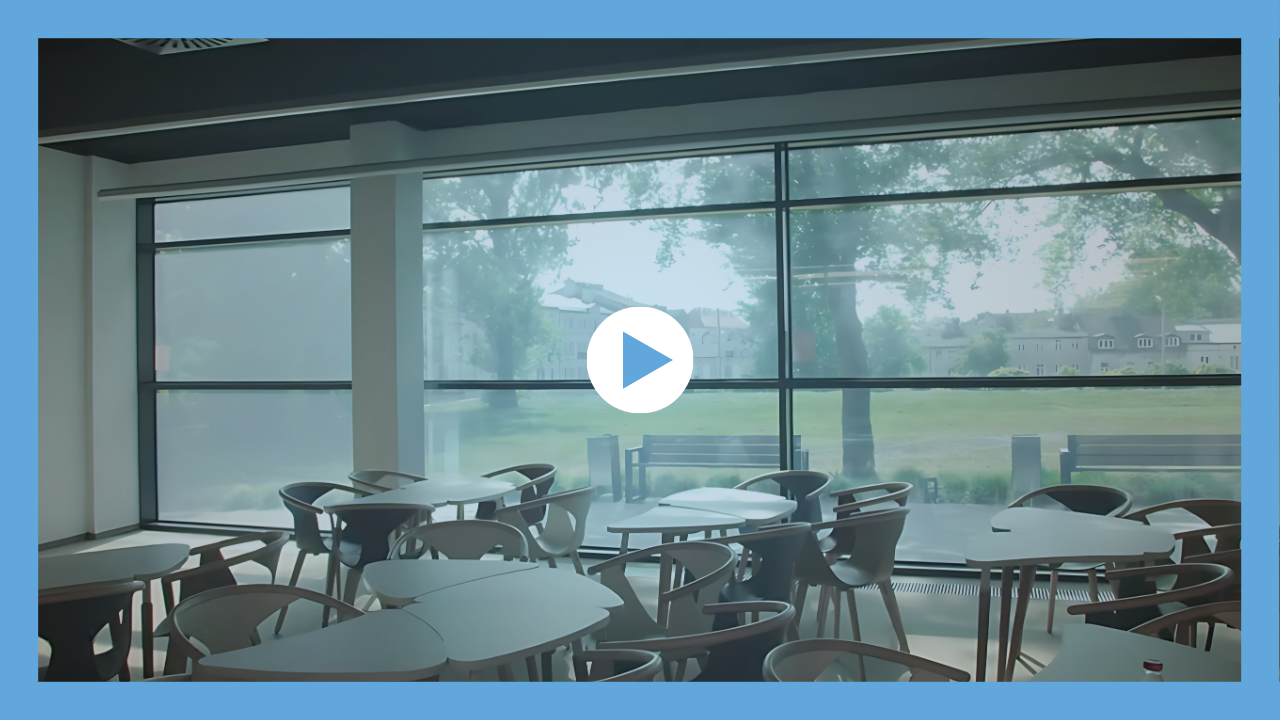
The film is 0.4 mm thick, roughly the thickness of four sheets of paper, and is applied from the inside to glass that is already installed in the wall. There is no need to replace the glass, erect scaffolding, or carry out façade work. The solution works on both single and insulating glass. This can be clearly seen at the 800th Anniversary Mediateka in Piotrków Trybunalski, where the film was applied to the glass façade and roof skylights, in places where blinds simply could not be installed.
When it is worth installing film on glazing
The film works well wherever glazing is visible from outside and the room serves different functions during the day. In banks and financial institutions, this usually means management offices and boardrooms on higher floors, workstations with client documents near windows, and rooms where conversations requiring discretion take place.
It also works well in buildings that are already in use, where replacing the glass is not an option, as well as on surfaces that cannot be covered in any other way: skylights, roof glazing, and tall façades.
A separate category includes places where confidentiality is a requirement of the work, not an added convenience. This was the case at the Rymarz Zdort Maruta law firm, where the film was installed to control what could be seen from the street.
Frequently asked questions
Does the film protect against a drone?
No. It protects against what can be seen through the glass. The drone can still fly over the building and record the façade, but with the film in its opaque state, it will not capture the interior, documents, or screens.
Can anything be seen through the film in its opaque state from up close?
Light and movement may be visible as blurred patches, without shapes or details. The film scatters at least 95% of incoming light, so no image is formed.
Does the film darken the room?
No. In its opaque state, it still lets in diffused daylight. It will not replace a blackout blind.
What happens if the power goes out?
The glass becomes opaque. The opaque state does not require power. Electricity is only needed to make the film transparent.
Can the film be installed on an existing façade without replacing the glass?
Yes. The film is applied to existing glazing from the inside, without replacing the glass and without any façade work.
Does the film work on insulating glass?
Yes, it works on both single and insulating glass, without replacing the glass unit.
Can only selected rooms be covered?
Yes. Glazing can be divided into independently switched zones, controlled by a button, schedule, or building management system.
Chcesz wdrożyć folię SONTE w swoim projekcie? Skontaktuj się z nami, a zaproponujemy najlepsze rozwiązanie.