

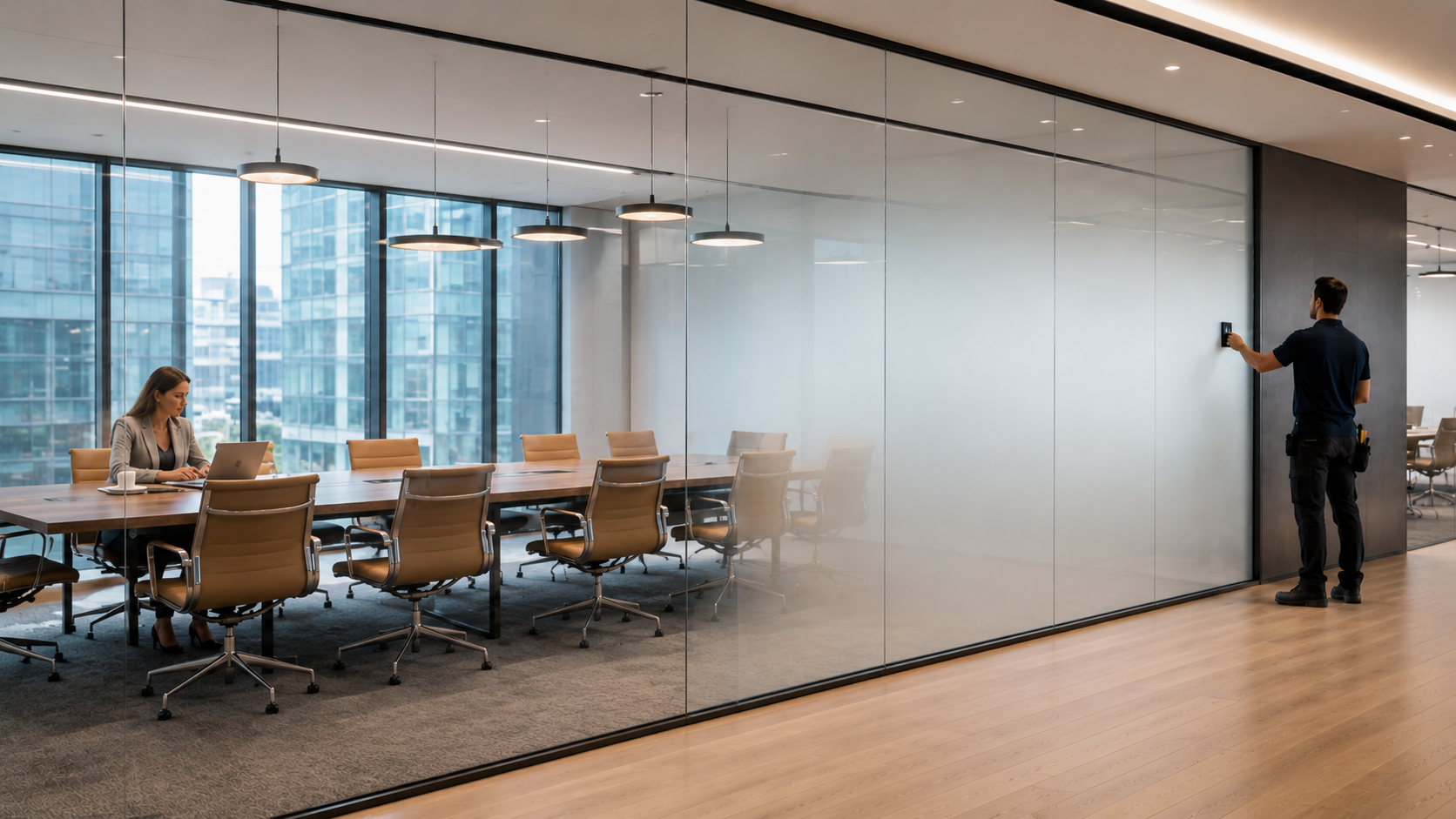
SONTE film installation in an office – 36 hours from delivery to system start-up
Contents
- SONTE film installation in an office - 36 hours from delivery to system start-up
- Where the need for privacy in a glazed office comes from
- Privacy is not blackout - the difference that determines the right choice
- Retrofit: the film is applied to glass already installed in the wall
- What is included in the 36 hours
- What happens after the handover protocol is signed
- Frequently asked questions about retrofit installation (FAQ)
Installing film on glazing in an active office is usually completed within 36 hours, from material delivery to the start-up of the finished system. During the work, only one room is taken out of use, not an entire floor or building. The film is applied to the glass that is already installed in the partition, so there is no glass replacement, no dismantling of the aluminium structure, and no wet works. Adjacent rooms can continue operating as usual.
This answers a question that usually comes up in conversations with building managers before the question about price. And rightly so, because in a commercial office, the cost of downtime can be higher than the cost of the installation itself. Below, we break down those 36 hours into stages, show the mistake that most often extends them, and explain what to expect after handover.
Where the need for privacy in a glazed office comes from
Class A offices are designed today with far more glass than they were a decade ago. Glass walls in conference rooms, partitions between open spaces and private offices, and glazed doors are now the standard, not a distinguishing feature. The purpose of this approach is clear: daylight reaches deeper into the building, the space appears larger, and the team can see one another.
The need for privacy comes later, and usually not at the design stage. Only everyday use reveals that this particular room is used for conversations that should not be lip-read through the glass, or that documents on a desk are visible from the corridor. This is not an oversight on the designer’s part. The function of the room has simply changed.
At this point, the building manager has several solutions to choose from that have worked well for years. Blinds and roller shades can be installed within a few hours and are relatively inexpensive. Frosted glass or decorative film provides permanent, maintenance-free privacy. Each of these solutions works perfectly well in many projects, and there is no reason to dismiss them.
The limitation appears when privacy is needed only temporarily. A roller shade has to be operated manually and blocks the view together with the light. Frosted glass remains frosted at all times. Replacing a pane in a partition wall system, on the other hand, means construction work, scheduling, and arrangements with the building manager.
Privacy is not blackout – the difference that determines the right choice
Before we move on to installation, it is worth separating two concepts that are most often confused in sales conversations and can lead to disappointment after installation.
Visual privacy means that shapes, silhouettes, and content displayed on screens are not visible through the glass. Blackout means no light in the room. These are two different functions, and they are delivered by different products. In its frosted state, liquid crystal film provides privacy: the glass becomes opaque, but still lets in diffused daylight. It does not darken the room and will not replace a blackout blind. If the goal is darkness, for example in a projection room or bedroom, a different solution is needed.
This difference is also the reason why the film is chosen for offices. In a conference room, darkness is rarely the goal. The goal is to make sure that, for an hour, no one outside can see what is on the screen, while people inside do not have to work under artificial light.
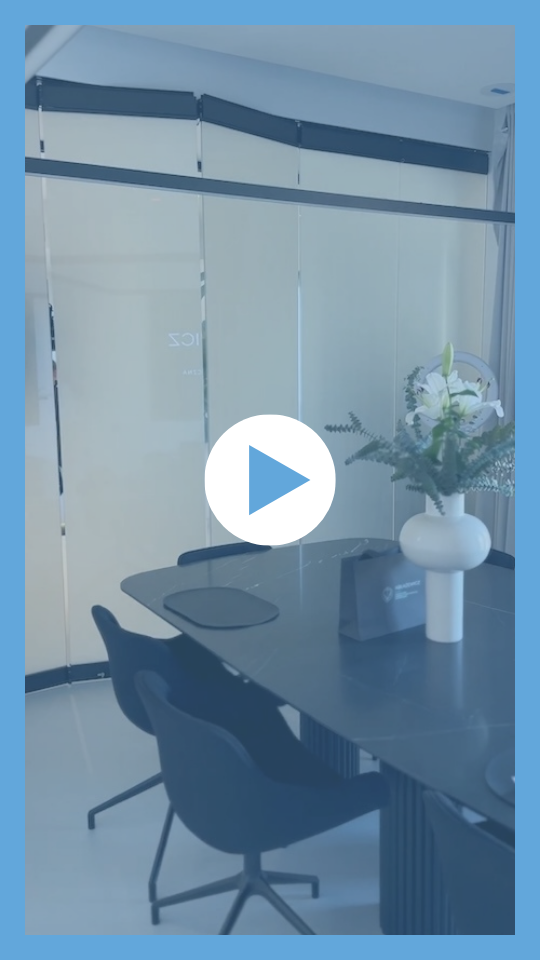
The solution we are talking about is SONTE, a liquid crystal film applied to existing glazing, which changes from frosted to transparent when voltage is applied. Liquid crystals are enclosed within the film layer. Without power, they are arranged randomly and scatter light, making the glass appear frosted. When voltage is applied, they align in parallel, light passes through directly, and the glass becomes transparent. This technology is known as PDLC.
The closest analogy is a blind in which all the slats rotate at the same time, except that here there are no mechanical parts, and the transition to the transparent state takes 10 milliseconds. A blink of an eye takes about 100 milliseconds, which is ten times longer. The return to the frosted state takes 200 milliseconds, roughly the time of two blinks.
Retrofit: the film is applied to glass already installed in the wall
Installation on glass that has already been fitted is called a retrofit. This is different from lamination, where the film is placed between two panes during the production of an insulating glass unit. In that case, the decision has to be made before the glass is ordered and cannot be reversed without replacing the entire unit.
The right option depends on the stage of the building. Lamination makes sense in a new investment, when the glass is still being ordered and the investor wants a perfectly smooth surface with no external layer. Retrofit is the right choice wherever the building is already completed and in use, as well as when the option of removing the film in the future needs to be preserved. After removal, the glass remains clean and undamaged, although the film itself cannot be reused.
The film is 0.4 mm thick, which is roughly the thickness of four sheets of office paper. It does not change the outline of the glass, does not interfere with the window opening mechanism, and does not require any changes to the aluminium structure. It works on both single and insulating glass.
The practical limits are defined by format. A single film sheet can be up to 5000 mm long, while the width is selected freely between 1000 and 2000 mm, as the film is cut to the specific required size. The widest format, 2000 mm, is available only for SONTE White. Wider glazing is divided into several strips operating from a shared power supply unit. On the finished glass wall, the joints are visible up close, which is why their layout is agreed before production, not during installation.
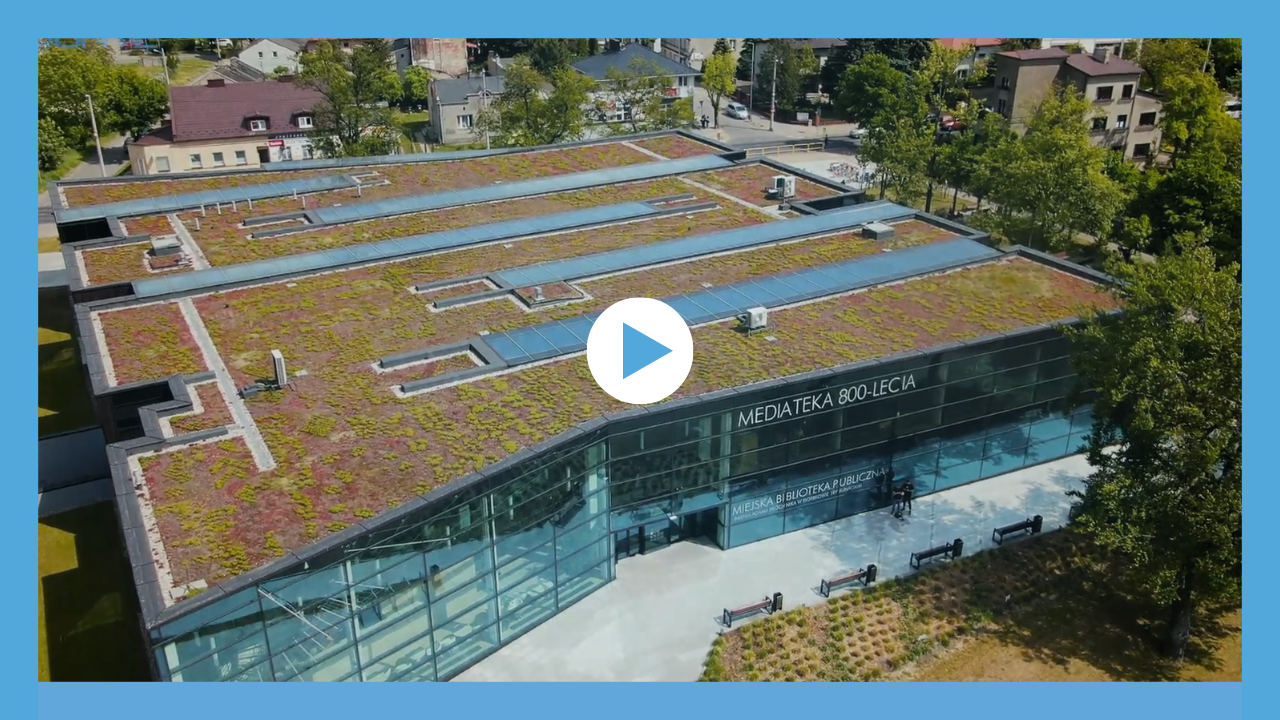
The most difficult case we have completed was not a wall, but a ceiling: SONTE film was applied to the roof skylights of the 800th Anniversary Mediateka in Piotrków Trybunalski, where blinds and curtains simply could not work.
What is included in the 36 hours
The timeframe is counted from the moment the material is delivered to the site to the start-up of the working system. It does not include production or technical analysis, which take place earlier. The 36 hours include four stages.
Glass preparation determines the durability of the entire installation, even though it is the least spectacular part of the process. The surface is washed, mechanically cleaned, and degreased. Film applied to glass that has not been prepared properly may start to peel at the edges after a few months, and at that point there is no real fix other than replacing the film sheet. This is the stage where saving time is not worth it.
Film application is the actual installation. The film is cut to size and applied with a controlled distance from the edge of the glass. This is the only moment when the room needs to be taken out of use. Adjacent rooms can continue operating as usual.
Connection of power supply and control. A two-core cable with a minimum cross-section of 2 × 0.5 mm² is routed to the film, and the power supply unit is connected to a 230 V AC / 50 Hz socket. Cabling is routed along the top or bottom of the glass, by the frame or in a cover strip, while the power supply unit is hidden in a suspended ceiling, technical floor, or inspection space. In the Clariant office at Monopolis in Łódź, the installation covered glass walls and doors in an open space, and it is not visible from any workstation. Visible installation elements after handover indicate an installation error, not a feature of the technology.
This is also the stage when the control method is selected: a wall switch, remote control, app, or building management system. The BMS version requires coordination with the automation specialist, because control is based on supplying and cutting off voltage at the power supply socket. If the building already has a central system, it is worth including the film in lighting scenarios straight away, not a year later.
Testing and the handover protocol close the timeframe. We check the film’s reaction, switching stability, correct electrical connection, and the aesthetics of the edge finish. In the transparent state, the film consumes 6 W per square metre. For a typical 10 m² glass wall in a conference room, this equals 60 W, roughly the same as a laptop charger. In the frosted state, it does not consume any power at all, because the absence of voltage is its resting state.
Before all of this comes the technical analysis, which is carried out separately and without interfering with the space. We check the type and condition of the glass, access to power, the possible cable route, and the height of the glazing. The last point can come as a surprise: with glass higher than 2800 mm, double electrodes are required, at both the top and bottom at the same time, which changes the way cables are routed. In offices with floor-to-ceiling glazing, this threshold is exceeded more often than it may seem.
The most common mistake before installation and the question we ask when preparing a quote
The most common mistake is treating the film like a blind, meaning ordering it without first determining where the power will come from. A blind can be installed almost anywhere. The film needs a power supply unit, and the power supply unit needs a socket and a place where it can be hidden. If this only becomes clear on the day of installation, the team has to wait for an electrician, and the 36-hour timeframe turns into two separate visits.
That is why we ask the same question with every quote: where is the nearest 230 V socket in this room, and is there enough space above the suspended ceiling or under the technical floor to fit the power supply unit? If the answer is “I don’t know”, that is not a problem. It is a signal that the technical analysis should take place before the order, not after it.
The second question concerns the height of the glazing, because of the 2800 mm threshold described above. These two pieces of information are enough to determine whether the installation can be completed within the standard timeframe.

What extends the installation time
Apart from the lack of power supply, there are three other typical causes. The first is issues that only become visible on site: scratched glass, remnants of old film, or unevenness in the pane. The second is curved glass and curved structures. Film can be installed on them, but this requires prior technical consultation and a different schedule.
The third is staging large areas. In an office operating at full capacity, it is rarely possible to take over all rooms at the same time, and usually it is not necessary. At the Rymarz Zdort Maruta law firm, the project was completed in two stages, while at Clariant it was carried out in four stages over two years, alongside successive room renovations. Installation does not have to be a single event.
It is also worth taking into account the time before delivery. The film is cut to specific dimensions, so production starts after the pro forma invoice has been paid, and standard delivery takes up to 14 business days. We prepare a quote within 24 hours of receiving the dimensions.
What happens after the handover protocol is signed
The warranty for the film is 40 months, while the power supply unit and accessories are covered for 24 months. The warranty period can be extended under the Smart Care programme, as well as when the client agrees to allow the project to be used in SONTE materials.
One condition is absolute: the warranty applies only when the installation is carried out by a certified team. Technically, the film can be applied independently, and some people do try. However, the consequence of an unsuccessful attempt is ordering a new film sheet, because once the film has been removed, it cannot be reused.
Maintenance is simple, with one restriction that often surprises building managers: cleaning robots are not allowed. The film should only be cleaned manually, using a microfibre cloth and a standard alcohol-free glass cleaner, with the power turned off. More difficult stains can be removed with isopropyl alcohol, applied locally. Vinegar, ammonia, steam cleaners, and abrasive agents are not allowed. At the Abłażewicz dental clinic in Czechowice-Dziedzice, the film was applied to walls as well as sliding and folding doors precisely because a smooth surface is easier to keep clean than the fabric of blinds.
Frequently asked questions about retrofit installation (FAQ)
1. How long does film installation take?
Usually up to 36 hours from material delivery to the site to the start-up of the working system. This timeframe includes four stages: glass preparation, film application, connection of power supply and control, and testing with a handover protocol. Technical analysis and production take place earlier.
2. Will the installation stop the office from working?
Only the room where the team is working is taken out of use. We do not replace the glass, interfere with the system structure, or shut down the entire floor. The work can also be carried out outside the team’s working hours.
3. Is the cabling visible?
Not when the installation is done correctly. A cable with a minimum cross-section of 2 × 0.5 mm² is routed along the top or bottom of the glass, by the window frame or in a cover strip, while the power supply unit is hidden in a suspended ceiling, technical floor, or inspection space. Dedicated cable outlets are available for different types of glazing.
4. Can the film be installed on insulating glass?
Yes. Retrofit installation works on both single and insulating glass, without replacing the glass unit.
5. Does the film provide full blackout?
No. In its frosted state, the film provides visual privacy: shapes and details are not visible through it, but it still lets in diffused daylight. It is not a blackout solution and will not replace a blackout blind.
6. Can I install the film myself?
Technically, yes, but we do not recommend it and such installation is not covered by the warranty. Once removed, the film cannot be reused, so an unsuccessful attempt means ordering a new film sheet.
7. Can only part of the glass be covered with film?
Yes, in any strip or section. Up to a height of approximately 2370 mm, no additional top electrode is required, which gives considerable flexibility for large glass surfaces.
8. Can the film be cleaned with a cleaning robot?
No. It should only be cleaned manually, with a microfibre cloth and with the power turned off.
Chcesz wdrożyć folię SONTE w swoim projekcie? Skontaktuj się z nami, a zaproponujemy najlepsze rozwiązanie.